
 UK
UK
 Ireland

Time to talk for family offices
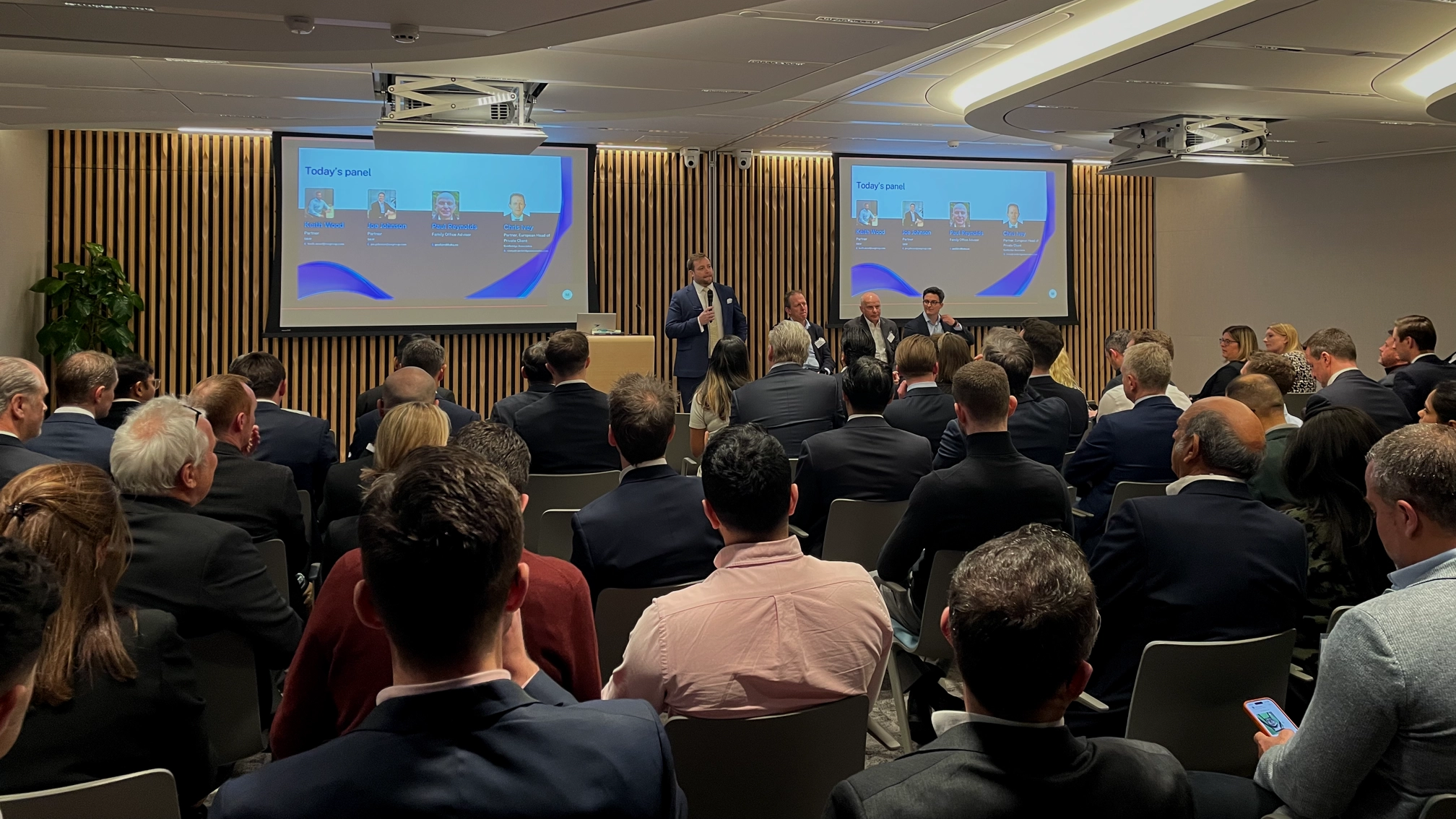


Our expert panel at S&W’s recent event for family offices explored trends in investment allocation amid geopolitical conflict, the importance of good governance and strategic planning, and the impact of tax changes.
In summary
- Family offices play a critical role in the funds ecosystem. Significant capital flows through these offices, and understanding them is key. S&W's event brought together top family offices and industry professionals to shed light on this often opaque world
- As the panel warned, investment allocation matters, but chasing the news cycle brings significant risk. Plans should be made strategically, in advance of global events.
- Good governance is critical, and the family offices that last prioritise it. Having difficult conversations is critical part of the process
- Families are facing a lot of tax changes, with significant individual and family impacts. Clients need to make sure they’re up to date with how these changes can impact you and your family
Family offices manage over $5.5 trillion globally. By 2030, that figure is expected to top $9trn. Over the next decade, 60% of family offices are expecting some sort of leadership transition. The impact of family offices, and opportunities in the space are seismic.
This is what Keith Wood, Partner at S&W, told an audience of nearly 150 people at our recent family offices event in London.
To discuss how family offices and their advisers navigate these opportunities, Wood was joined by an expert panel, bringing decades of experience with family offices:
- S&W’s Joe Johnson, a Partner in the private client tax team, who advises individuals and families with an international aspect to their affairs
- Paul Reynolds, the “family office guy”, an industry veteran with 40 years’ experience working with single-family offices, a multifamily office and a private bank
- Chris Ivey, Partner and European Head of Private Client at investment firm Cambridge Associates, which manages $313 billion in investment allocation across private clients and institutional endowments, pension funds, and more.
As the panel discussed, the conflict in the Middle East has created an uncertain outlook for family offices’ investments. Around that, however, there are no easy answers. As Ivey put it, “When the major protagonists don't know when it's going to end, it's hard for anyone else to know.”
As the panel observed, however, family offices are not simply investment vehicles. They serve the family and its different needs and lifestyles.
As Wood put it, “It's not just about the headline return.”
The importance of good governance
Consequently, as well as discussing investment strategies, the panel covered a wide range of issues. Among them was ensuring fairness between family members. That, more than even investment returns, is key to a family office’s success, according to Reynolds.
The first role of a family office or an adviser is to try to ensure that the dynamics of the family stay together.
“If you haven't found a structure for your family or for the families you work for that's fair to the family members, then by definition, your structure is unfair,” he warned.
In part, it helps to ensure that each member has their own liquidity, so that they can finance their plans, whether to fund a new kitchen, start a business or buy a house, without recourse to others.
“When the family member wants to do something, they shouldn't have to go to the trust or the board,” said Reynolds. “It could be pretty soul-destroying for a successful young person to always ask for funds.”
It is ultimately a governance issue, rather than an investment issue, and putting structures and processes in place at the outset is the surest way to avoid problems.
If you look at those that have successfully managed to pass wealth down through multiple generations versus those that haven't, governance is clearly the one thing that works.
Hard conversations for soft landings
What good governance looks like varies from office to office. Like those they serve, every family is unique. Getting the right governance structure, policies and processes in place for each (perhaps by starting with an audit) is helped by having the relevant conversations before they’re required, however.
As Reynolds explained, considering difficult questions in the abstract enables the family office to debate issues and develop its approach without the emotion that comes when it results from a specific request.
“When you’re talking about it in a hypothetical sense – What happens if..? – everybody can do it without getting upset,” he said.
“As soon as a family member asks, it becomes personal… Then it becomes much harder.”
Those running the family office should continually be considering situations that might arise or requests they might receive and develop the documents and policies to define their approach.
In fact, if there’s a silver lining to recent volatility around tax rules, it’s this, Johnson added.
“Clients are being forced to have those difficult conversations,” he said.
Tax changes: Keeping it in place
As Johnson told the audience, recent changes have seen a significant overhaul of the UK tax regime for many of his clients.
There’s been a whole load of changes over the last two years and an enormous amount of volatility in the system.
These include the elimination of the UK’s non-dom regime after almost 200 years; its replacement with the foreign income and gains (FIG) regime; and significant changes to the treatment of offshore trusts for inheritance tax. More recently, families have had to contend with restrictions on business and agricultural property relief.
“It’s an extremely busy time to be a tax adviser,” said Johnson.
The changes may not be welcome in many respects, but they may mean families can simplify arrangements in some cases. After all, if complex tax structures no longer provide protection against liabilities, do they need to remain?
Either way, the conversations need to take place, said Johnson. Many family offices in the past failed to review their structures regularly, but that’s no longer an option. While tax is usually secondary to investment decisions, the consequences of failing to consider it can be that it comes to dominate them, Johnson warned
“You could go into a certain asset class to try to tweak your performance, but do you have the liquidity to meet the tax liabilities?”
As he put it, “Tax a lot of the time is the minor part, but without active engagement, it can very quickly become the major part or even the only problem if you don't have a plan.”
Future fund events
This family office event was the kickoff of a wider event series called the Funds Ecosystem. The series brings together key players across the investment funds landscape to share insights, solve challenges and accelerate growth.
Family offices are a great way to begin this discussion and event series:
- They act as both direct allocators in the funds industry and a significant capital source that is pooled by more institutional allocators like Cambridge Associates
- The $5.5trn in assets that family offices manage is a more significant contributor to the investments funds ecosystem than people realise. Rising to $9trn by 2030, it will become an even more critical player
- Family offices are often more agile than other institutions, so that they end up being first movers into new and exciting strategies. Anecdotally, seed partnership with family offices and upstarting investment managers is on the rise
Finally, if you look at what family offices do – pool capital, make investment decisions, manage risk, and establish governance – there are a vast number of parallels with investment funds. Consequently, the answers to many of the challenges around governance for family offices can be found by looking to the funds industry.
Find out how we could help
If any of these topics resonate, please reach out to Keith Wood for an informal initial chat. Chances are, we can help solve the challenge or know the people who can.
You can also find out more about our family office and private wealth services.